
This is my recount of the Mahakumbh experience, where I witnessed both magic and madness! It has been just half a day since I returned, yet I find myself overwhelmed and amazed—for reasons both good and bad. It is usually in this state of disillusionment that I turn to writing. The process of putting my thoughts into words is truly calming, so here it goes.
Let’s talk about madness first because, honestly, that’s what I encountered the moment we arrived in Prayagraj.
Madness #1: The Traffic Nightmare
The first dose of madness hit us just five kilometers before the mela grounds, where we got stuck in an absolute traffic jam. It took us about three hours to clear it—and that was with the help of a friend who worked at the Mela and managed to get us past some barricades. The traffic police were desperately trying to divert and reroute vehicles using all the mathematics they could, but the sheer number of pedestrians on the roads made it impossible to move beyond 5 km/hour.
Madness #2: The Sheer Massiveness of the Crowds
I truly believe we need a new word in the dictionary to describe crowds of this magnitude. LAKHS of people—walking, eating, chanting, shouting, praying, sleeping, jumping, taking selfies, fainting, laughing, dancing, bathing, changing, singing, gasping (this was me most of the time!)—all engaged in every possible human action at once. The chaos was mind-numbing, almost like stepping into another dimension of reality. Add to this the constant wail of sirens announcing missing persons, loudspeaker warnings about safety, and live concert performances, and you have a sensory overload like no other.
Madness #3: The Lack of Civic Sense
I love my country, but we are still far from being truly loyal to our motherland. Despite the thousands of dustbins available, many chose to litter, spit on the very land they call holy, and push through crowds (I did not experience this but referring to the stampedes that happened)—all while claiming they had come to erase bad karma. The FOMO on the Mahakumbh drew in many who were there more for social media glory than for spiritual growth, diminishing the experience for those who genuinely cared.
I haven’t done extensive research into the root cause of this herd mentality, but my gut tells me it stems from poverty and the quality of education. The more we work to elevate people’s lives and empower them with critical thinking, the sooner we will foster true, nation-loving citizens.
Some may argue that improving this situation is easier said than done, especially in a country like India, which is dealing with the legacy of colonization, poor governance, corruption, and an ever-growing population. But I am an eternal optimist. So, instead of just complaining, here are a few simplistic yet actionable solutions:
Possible Solutions to the Madness
- Restrict entry into the Mela to a manageable number per day.
This can be done through a combination of online and offline ticketing systems. Currently, there are no entry restrictions, which means authorities cannot predict or control the number of people showing up. While I understand that this is a religious event and restricting access might seem unfair, with proper planning, it is possible to allow 500 million visitors—but in organized, manageable batches. - Extend the Mela beyond its physical grounds.
Just as election campaigns involve widespread propaganda and information-sharing, the Kumbh should also include nationwide education on safety protocols, civic responsibilities, and behavioral expectations. The transportation systems must be upgraded to prevent ticketless travel, which contributes to unexpected overcrowding. The current railway ticket-checking system, where TTs check tickets after passengers board, needs rethinking. Implementing DigiYatra-style screening at railway stations could help regulate crowds. - Reduce political branding and improve informational signage.
While politicians and religious leaders worked hard to organize the event, the mela grounds felt more like a giant advertisement space for them. Every second hoarding featured a politician posing, which served no real purpose. Instead, these could have been replaced with maps, emergency numbers, warning signs, or even cultural illustrations explaining the spiritual significance of the event. A beautiful app was created for the Mela, but not everyone is tech-savvy. Clear, physical maps and signs are still necessary. As a marketer, I truly believe that subtle, indirect messaging should extend to politics as well.
Now, let’s move on to the MAGIC!
Magic #1: World-Class Infrastructure
The infrastructure built for Mahakumbh was beyond impressive! We travelled from Lucknow to Prayagraj on brand-new six-lane highways. The city of Prayagraj received a major upgrade, with fantastic bridges and roads. Once inside the Mela grounds, there was no shortage of food or water. Free meals were available for those in need, reasonably priced meals were accessible for budget travellers, and fancy food courts catered to those who wanted gourmet options. I was stunned to find exotic treats like hazelnut coffee, chocolate brownies, and kombucha!
The makeshift tent cities and pontoon bridges along the banks of the Yamuna and Ganga were brilliant. At least one lakh toilets and changing rooms were set up at the ghats, and incredibly, there was no foul smell. Aside from littering near food stalls, the ghats themselves were remarkably clean.
Magic #2: Technology at Its Best
The Mahakumbh app helped us plan our visit in advance. A friend involved in organizing the event explained how a two-year-long effort went into developing digital interventions to prevent people from getting lost. Standard operating procedures (SOPs) were in place to track and reunite lost individuals with their families. Local police, intelligence agencies, NGOs, and government officials worked as one cohesive unit. All important locations for the 10 kilometers radius were mapped on Google maps – the first time for Google implementing this for a temporary city!
A state-of-the-art digital center was also created to showcase the story of Samudra Manthan and provide information on the deities associated with Prayagraj.

Magic #3: The Devotional Vibe
Never in my life have I felt such an overwhelming spiritual energy. Despite the 10–15% of visitors chasing social media clout, the majority were there for genuine devotion. The chants of Har Har Mahadev, Jai Ma Ganga, and Ram Ram echoed in a way that felt almost magical.
Even amid the madness, I experienced an inner calm. At 4 AM, we walked toward the Triveni Sangam Ghat with 2–3 lakh other devotees. didn’t experience a single forced push, no glaring stares or inappropriate touching. It was crowded, yes, but I had a constant smile on my face. As we approached the ghat, I truly felt the presence of the divine.
Magic #4: The Clean Waters
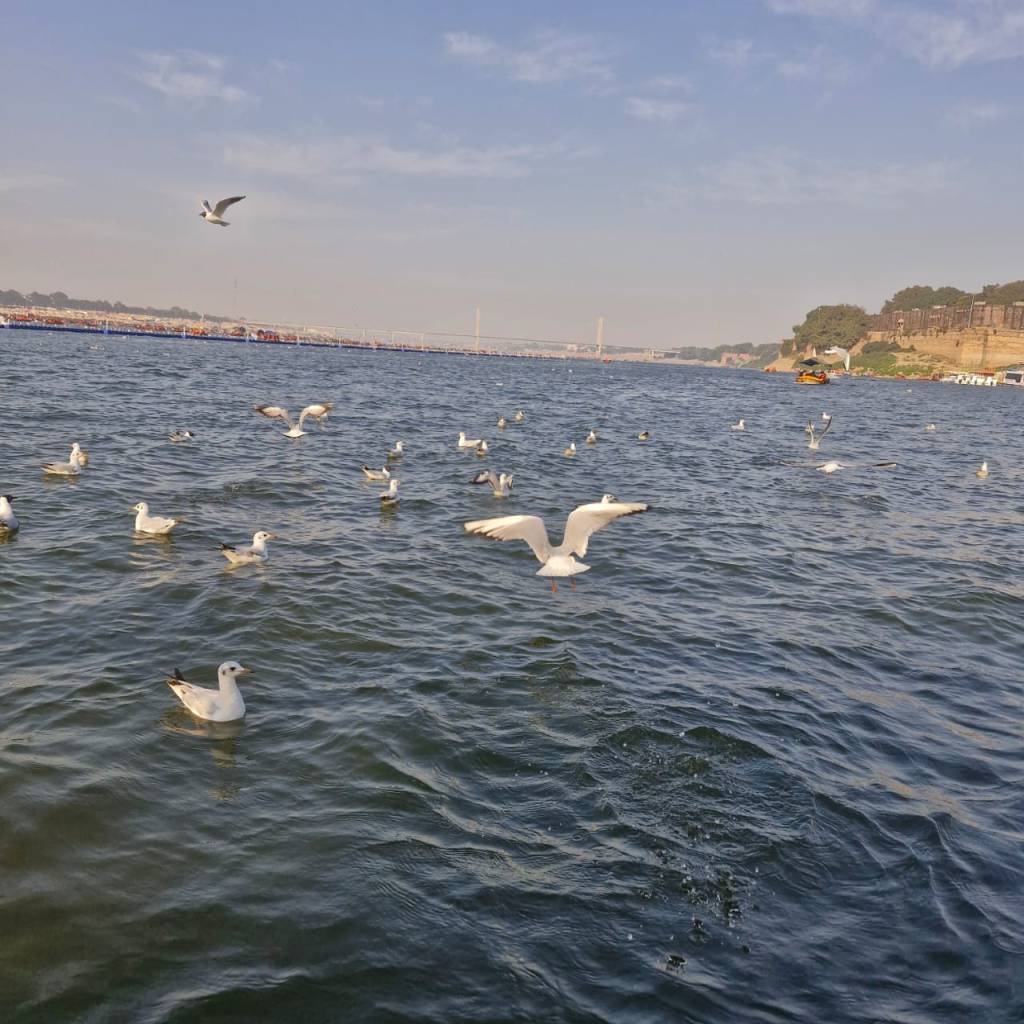
I visited Prayagraj 15 years ago, and back then, the water at the Sangam was far from clean. This time, however, the water at all the ghats was crystal clear! Filtration plants and cleaning boats operated continuously to ensure hygiene.
Magic #5: The Dips in the Sangam
As I grow older, my connection to Sanatan Dharma deepens. Under the guidance of my spiritual mentor,Ajay Chaturvedi, I took nine dips in the holy waters. These dips felt profoundly different from a casual dip in a pool. There was an inexplicable magnetic pull in the water—something that calmed me at an almost subconscious level.
After discussing this experience with my uncle, Dr. Vidur Jyoti who is also my guide and the most learned in my family, I learned that it could be explained scientifically by the alignment of Jupiter, Earth, and the Sun during this period. Jupiter, a planet 1,300 times the size of Earth, exerts its maximum magnetic influence during the Kumbh. In Vedic astrology, Jupiter (Brihaspati or Guru) symbolizes spiritual growth and wisdom. It is believed that during the Mahakumbh, this alignment amplifies spiritual energy, almost as if Brihaspati himself is absorbing and blocking negativity.
My uncle, Dr. Vidur Jyoti, beautifully summed it up with a shloka from the Purusha Sukhta:
“What I saw and felt at the Mahakumbh was the realization that God is in others, everywhere, and within.”
सहस्रशीर्षा पुरुषः सहस्राक्षः सहस्रपात् ।
स भूमिं विश्वतो वृत्वात्यतिष्ठद्दशाङुलम् ॥१॥
Sahasra-ṣīrssā Purussah Sahasra-ākssah Sahasra-Pāt |
Sa Bhūmim Viśvato Vrtva-ātya[i]-ṭisstthad-ḍaśa-āngulam ||1||
The purusha (universal being) has thousand heads, thousand eyes and thousand feet. Thousand signifies innumerable which points to the omnipresence of the universal being. He envelops the world from all sides i.e. he pervades each part of the creation, and extends beyond in the ten directions represented by ten fingers.
Just like Ganga (clear and pure) signifying Bhakti, Yamuna (muddy and dark) signifying karma and the mystical Saraswati (invisible) signifying Gyaan come together and become one, we must try to balance our lives in a way that knowledge and belief in God steers us to do the right actions for ourselves, our families and our country.
The Magic definitely outweighed the maddness for me and I am eternally grateful and blessed to have had a magical and safe experience. I hope I can visit the mahakumbh again with my family.
Har Har Mahadev!

 The Jyoti Girl
Leave a comment